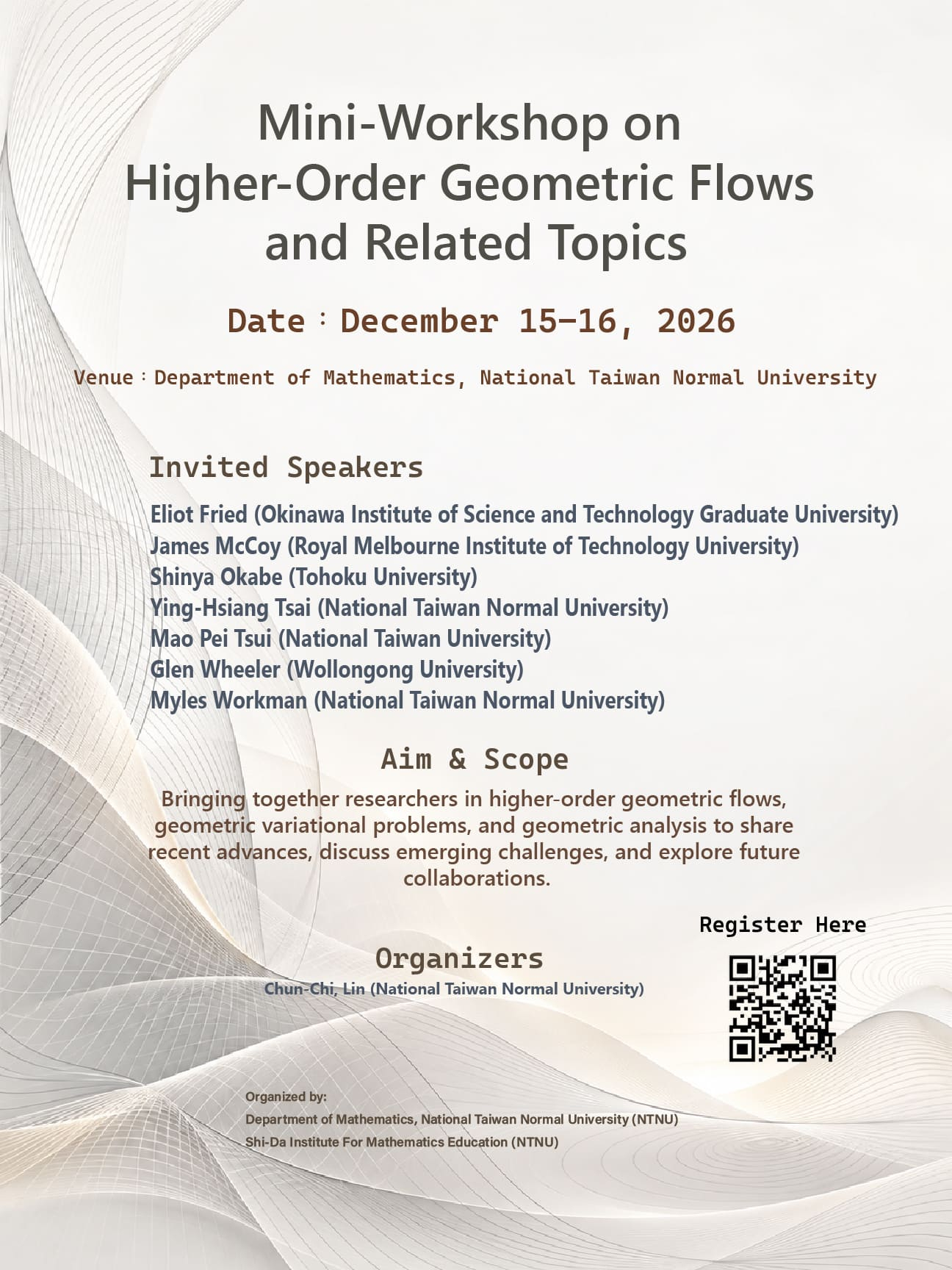
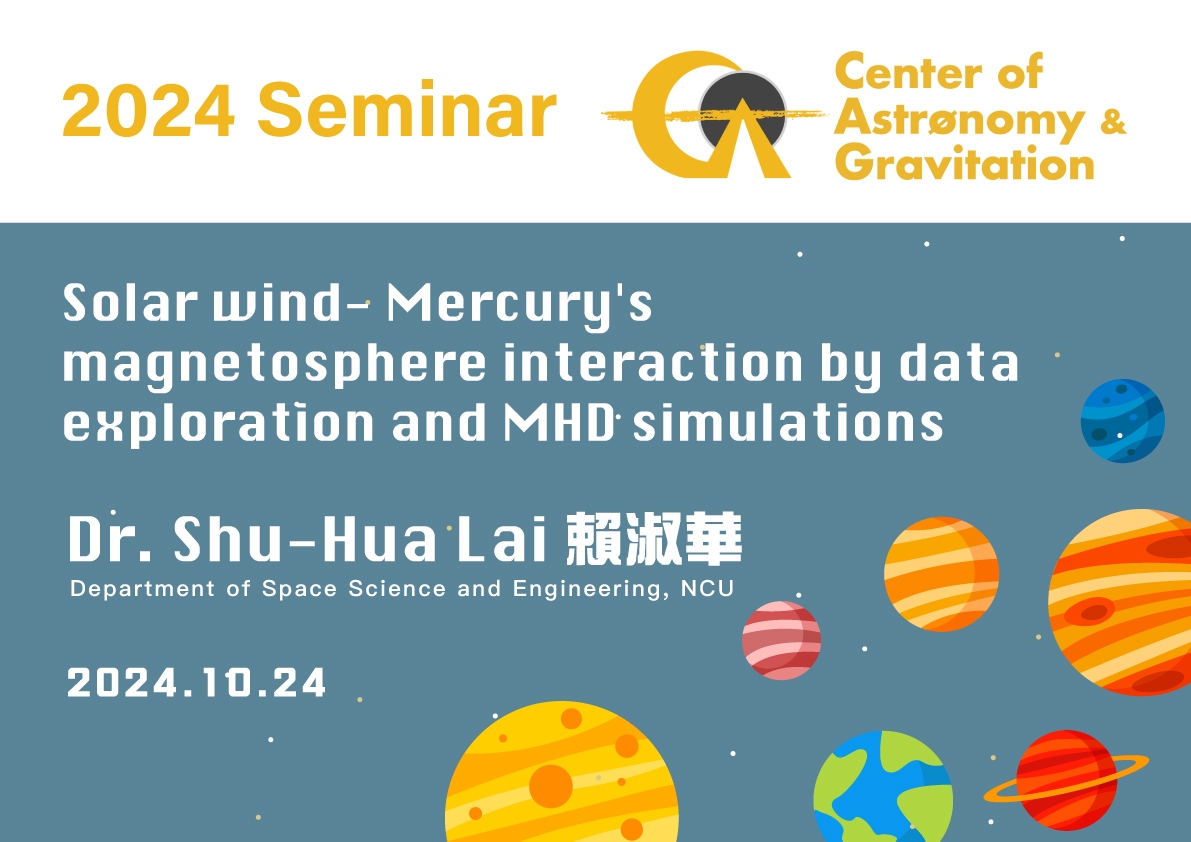
天文與重力中心演講【Solar wind- Mercury】
 活動舉辦:
結束日期:2024-10-24 13:20
活動類別:學術活動
報名方式: 免費
活動網址: https://www.cag.ntnu.edu.tw/index.php/seminars-2024-zh/
參加對象: 教職員,學生,校友,其他
聯絡人: 天文與重力中心
連絡電話: 天文與重力中心
電子郵件: cag@deps.ntnu.edu.tw
Abstract:
The semidiurnal (12.42 h) and semimonthly (14.76 days) lunar tides have been well-known by fishermen for several centuries. The gravitational force of the relative positions between the Sun, the Moon, and the Earth results in two symmetrical tidal bulges (double bulges) appearing at equatorial latitudes directly under and opposite the Moon. Ionospheric GNSS (Global Navigation Satellite System) radio occultation soundings reveal the global three-dimensional structures and dynamics of the double bulges of Earth’s upper atmospheric lunar tides for the first time. The double-bulge amplitude of ionospheric F2-peak height hmF2, lagging the sublunar or antipodal point by about 2–3 h, is about 3–5 km at the equator and 1.5–2.0 km at ± 35° magnetic latitude. The electron density further depicts global three-dimensional plasma flows in the ionosphere. Meanwhile, the most prominent feature in the ionosphere is the equatorial ionization anomaly (EIA), which is characterized by two enhanced plasma crests at low latitudes straddling the magnetic equator. Global ionosphere maps of total electron content are analyzed to see how the ionospheric EIA crests respond to changes in lunar phases. The results show that the EIA crests exhibit prominent semimonthly lunar tides with 14.77‐day period. Appearance times of the EIA crests on new/full moon (first/third quarter) lead (lag) those on the associated average by about 20–40 min, while the EIA crests move the furthest poleward during new/full moon and equatorward during first/third quarter with the delays of about 2–5 days. These indicate that the lunar phase can significantly modulate the ionospheric EIA.
Speakers
Dr. Jann Yenq Liu 劉正彥 (CAPE, DSSE, CSRSR, NCU)