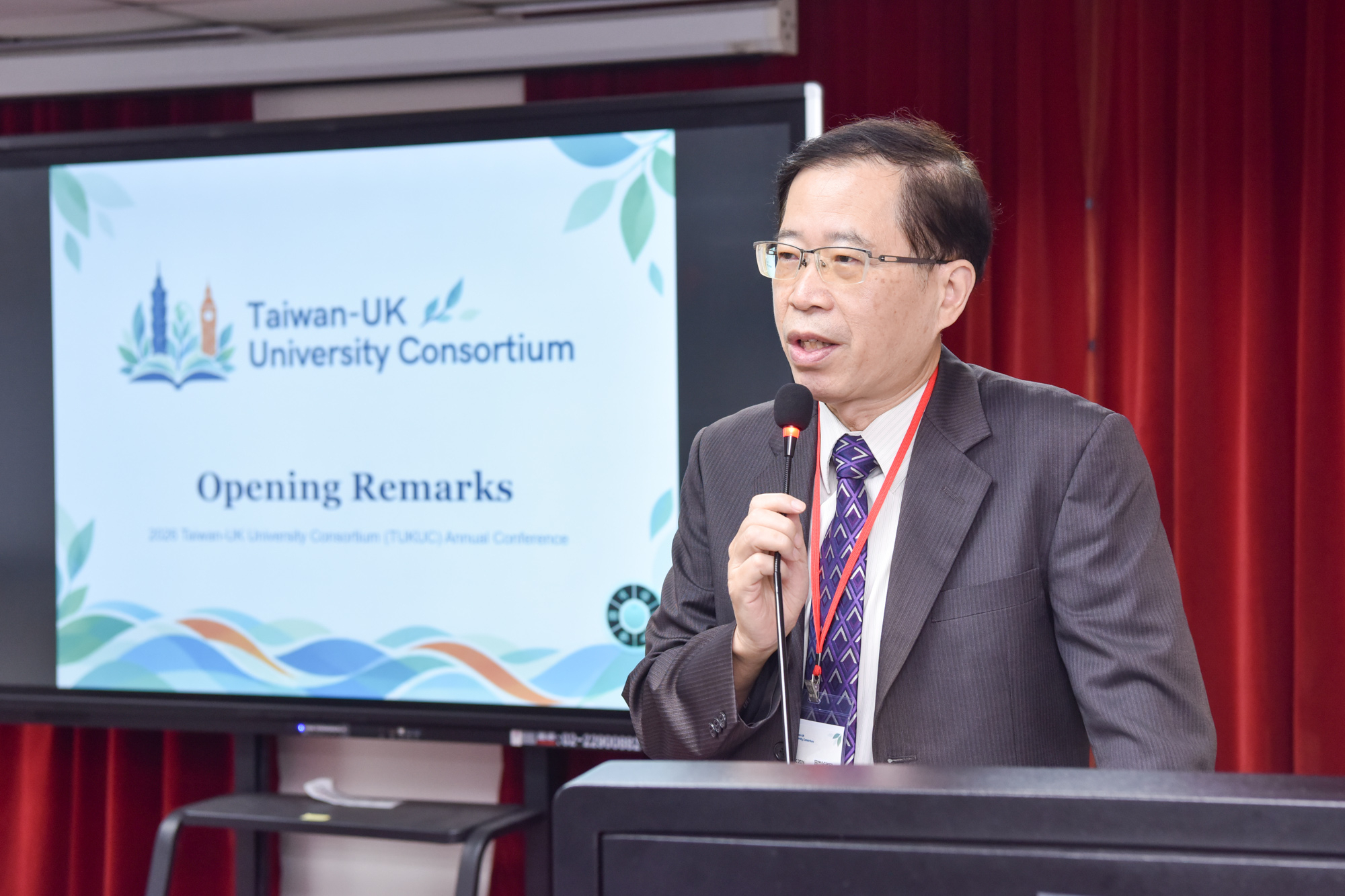
National Taiwan Normal University (NTNU) hosted the third annual meeting of the Taiwan-UK University Consortium (TUKUC) on October 27, bringing together representatives from eight universities in Taiwan and the United Kingdom to advance research collaboration in green energy, net-zero solutions, and bilingual education.
Supported by Taiwan’s Ministry of Education (MOE) and the British Council, the two-day meeting provided a platform for interdisciplinary research, academic exchange, and the development of long-term international partnerships.
NTNU President Highlights Cross-Border Research and Early-Career Scholars
The consortium comprises four universities in Taiwan—NTNU, National Taiwan University (NTU), National Tsing Hua University (NTHU), and National Sun Yat-sen University (NSYSU)—and four UK institutions: the University of Edinburgh, Newcastle University, the University of Liverpool, and the University of the West of Scotland. The annual meeting featured keynote presentations, parallel research sessions, and presentations by early-career researchers, focusing on two principal areas: Green Energy and Net Zero Solutions, and Bilingual Education.
Opening remarks were delivered by Joyce Yu-Jiuan Lee, Director General of the Department of International and Cross-strait Education at the MOE; Susan Milner, Director Taiwan at the British Council; and NTNU President Yao-Ting Sung.
Lee highlighted the consortium's achievements in net-zero emissions, green energy, and English-medium instruction (EMI). She also noted that collaboration has gradually expanded into emerging fields, including artificial intelligence, drones, and robotics. Beyond research outcomes, she emphasized the importance of in-person exchanges in building lasting academic relationships.
Welcoming delegates from Taiwan and the UK, NTNU President Yao-Ting Sung highlighted the consortium's continued collaboration in two key areas: Green Energy and Net Zero Solutions, and Bilingual Education. He noted that joint research teams are exploring renewable energy technologies, circular economy practices, and carbon governance to support the transition toward net-zero emissions by 2050. In bilingual education and English-medium instruction (EMI), researchers are working to improve teaching approaches, develop classroom observation frameworks, and strengthen teacher autonomy.
Sung also emphasized the importance of international academic exchange and EMI in preparing students for a globalized world. With NTNU's diverse international student community, he expressed hope that the annual meeting would encourage cross-cultural interaction and further cooperation in bilingual higher education.
Looking toward the future, Sung highlighted the meeting's dedicated sessions for early-career researchers (ECRs), which aim to foster mentorship and long-term academic collaboration across generations. He concluded by thanking the Ministry of Education and the British Council for their continued support of Taiwan–UK academic partnerships.
Strengthening Research Partnerships Across Taiwan and the UK
British Council Director Taiwan Susan Milner reflected on the trust developed between the two countries since the signing of their memorandum of understanding. She noted that Taiwan and the UK share important characteristics as island democracies and that the consortium has contributed to academic mobility, joint research, and the internationalization strategies of participating universities.
Hsiao-Wei Yuan, Vice President for International Affairs at NTU, discussed the university's efforts to strengthen partnerships with UK institutions. Over the past two years, NTU has supported interdisciplinary research projects and academic mobility initiatives that bring together researchers and students from different fields.
Galit Shmueli, Vice President for Global Affairs at NTHU, recalled her experience studying Chinese at NTNU. She praised the consortium's interdisciplinary approach, which connects areas as diverse as green energy, sustainability, and language education. She emphasized the importance of combining academic expertise with interpersonal connections to build meaningful partnerships across national and disciplinary boundaries.
Ming-Hsuan Lee, Vice President for International Affairs at NSYSU, reviewed the consortium's development since its inaugural annual meeting in 2024 and presented the outcomes of the MOE-supported Taiwan–UK collaboration initiative. Over the past two years, Taiwanese member universities have collectively undertaken 26 joint research projects with UK partners. The initiative has also facilitated nearly 100 academic visits and provided opportunities for dozens of students to study or participate in academic exchanges in the UK.
The meeting featured presentations addressing policy challenges and educational practices in the consortium's two principal research areas, fostering interdisciplinary exchange and sustained academic cooperation. For NTNU, hosting the event provided an opportunity to strengthen international partnerships in sustainability research and bilingual higher education while supporting the next generation of researchers.