


|
|
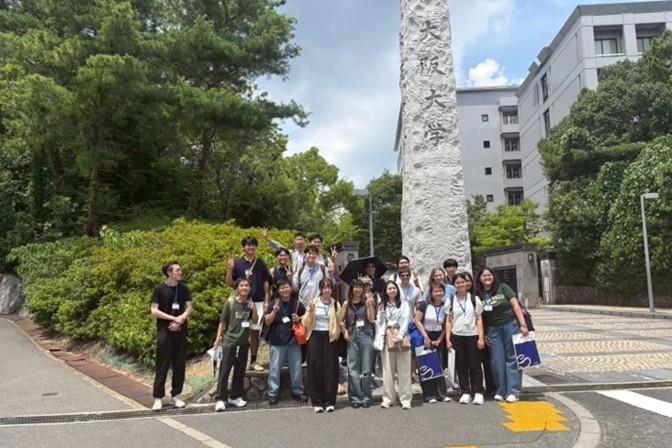
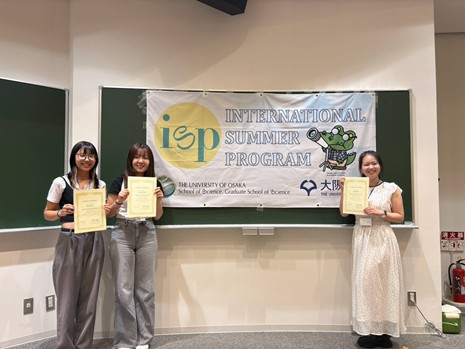
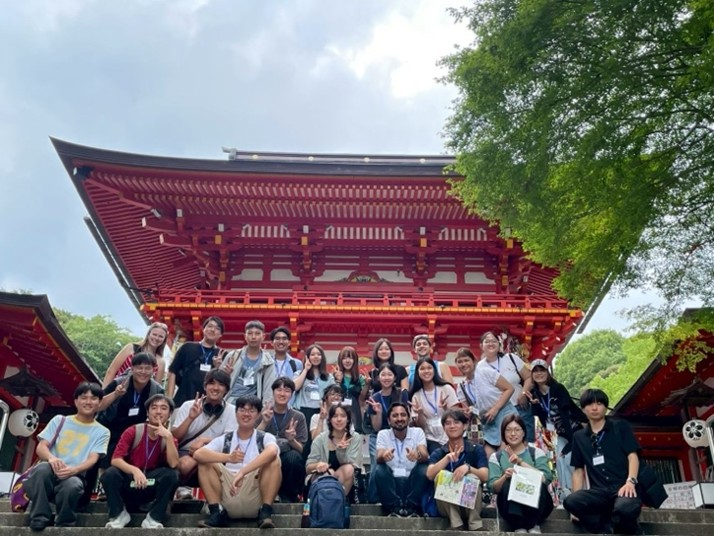
Three master’s students from the Department of Chemistry at National Taiwan Normal University (NTNU) participated in the International Summer Program (ISP) at the University of Osaka’s Graduate School of Science from July 16 to August 27, 2026. During the six-week program, the students joined research laboratories, conducted individual research projects, and presented their findings, gaining experience in an international research environment while building on the longstanding partnership between the two universities.
Six-week research program builds skills and independence
The ISP provides undergraduate and master’s students in the natural sciences and related fields with opportunities to conduct laboratory research at the University of Osaka. The program combines research projects and presentations with academic, social, and cultural activities.
Liu, a master’s student in Associate Professor Yi-Hsin Liu’s laboratory, joined the Ueda Laboratory to study porous nanomaterials and confinement effects. Using nuclear magnetic resonance (NMR), solid-state NMR, and differential scanning calorimetry, she investigated how pore size affects liquid-liquid phase separation in a 2,6-lutidine/water system.
Reflecting on the experience, she said international engagement requires more than research expertise and English proficiency. Understanding different cultures, respecting different ways of life, and learning to build relationships with people from different backgrounds are equally important. The program also encouraged her to consider further opportunities for overseas research, study, and international collaboration.
Shi and Huang, master’s students working with Professors Ling-Hsien Tu and Yi-Chun Yeh at NTNU, joined the Kajiwara Laboratory, where they worked on peptide synthesis, purification, and cyclization. Using solid-phase peptide synthesis, high-performance liquid chromatography, and liquid chromatography-mass spectrometry, they compared the cyclization behavior of peptides with similar sequences.
Huang completed the synthesis and purification of des-Asn⁵-oxytocin and natural oxytocin and obtained preliminary results for further study. Shi was able to quickly adapt to the laboratory’s procedures by drawing on her previous experience with peptide research at NTNU. She also observed differences in research management and laboratory safety practices at the University of Osaka.
For Shi, one of the most valuable aspects of the program was experiencing how a Japanese university laboratory operates. Although the reagents and equipment differed from those used at NTNU, she found that her previous training in peptide synthesis allowed her to adapt quickly. Huang said the experience showed her that research often requires repeated verification before reliable conclusions can be reached. Having previously given little thought to pursuing a doctorate or studying abroad, she began seriously considering a dual-degree program between NTNU and a Japanese university after experiencing research and daily life in Japan.
All three students completed their research presentations and program requirements. Beyond laboratory techniques, they gained practical experience in English-language academic discussions, intercultural communication, research planning, and problem-solving. The experience also prompted some of the students to reconsider the possibility of doctoral study and international dual-degree programs.
Building a pathway from exchange to research and dual degrees
NTNU and the University of Osaka have maintained an academic partnership since signing a university-wide cooperation agreement in 2011. Since 2023, NTNU’s Department of Chemistry has advanced a doctoral dual-degree program with the University of Osaka’s Graduate School of Science, allowing doctoral students to study and conduct research at both institutions under joint supervision.
Professor Emeritus Takumi Konno of the University of Osaka’s Graduate School of Science, who also serves as a visiting professor at NTNU, has played a key role in strengthening this partnership. Over the years, he has facilitated faculty visits, student exchanges, research collaboration, and institutional coordination between the two universities. During the students’ stay in Japan, Konno also provided guidance and support as they adjusted to their research and daily lives.
In October 2025, a delegation from NTNU’s Department of Chemistry visited the University of Osaka to discuss doctoral dual-degree admissions, student exchanges, research visits, lab-to-lab collaboration, joint research, and opportunities to collaborate on projects involving major international research facilities.
These efforts are helping establish a continuous pathway from undergraduate exchanges and short-term study programs to master’s-level summer research internships, doctoral dual-degree programs, and collaborative research.
The universities have further expanded their exchanges through the SAKURA Science Program, short-term research visits, graduate internships, and faculty exchanges. These opportunities introduce students to international research environments while enabling faculty members to establish closer research connections across institutions.
NTNU’s Department of Chemistry expressed its appreciation for Konno’s longstanding contributions, which have helped transform individual academic exchanges into a sustained, institutionally supported partnership between the two universities.
Expanding from student training to international research
The Department of Chemistry said the three students’ completion of the ISP and their research presentations reflected more than individual academic achievement. Their ability to join research teams, adapt to new laboratory environments, conduct experiments, and present their findings also demonstrated the foundation provided by their training at NTNU.
Building on these experiences, the department plans to further develop doctoral dual-degree programs, student exchanges, research internships, faculty visits, and lab-to-lab collaboration with the University of Osaka. Through sustained institutional cooperation and two-way exchange, the two universities aim to provide more opportunities for young researchers to develop scientific expertise, international experience, and intercultural communication skills.

