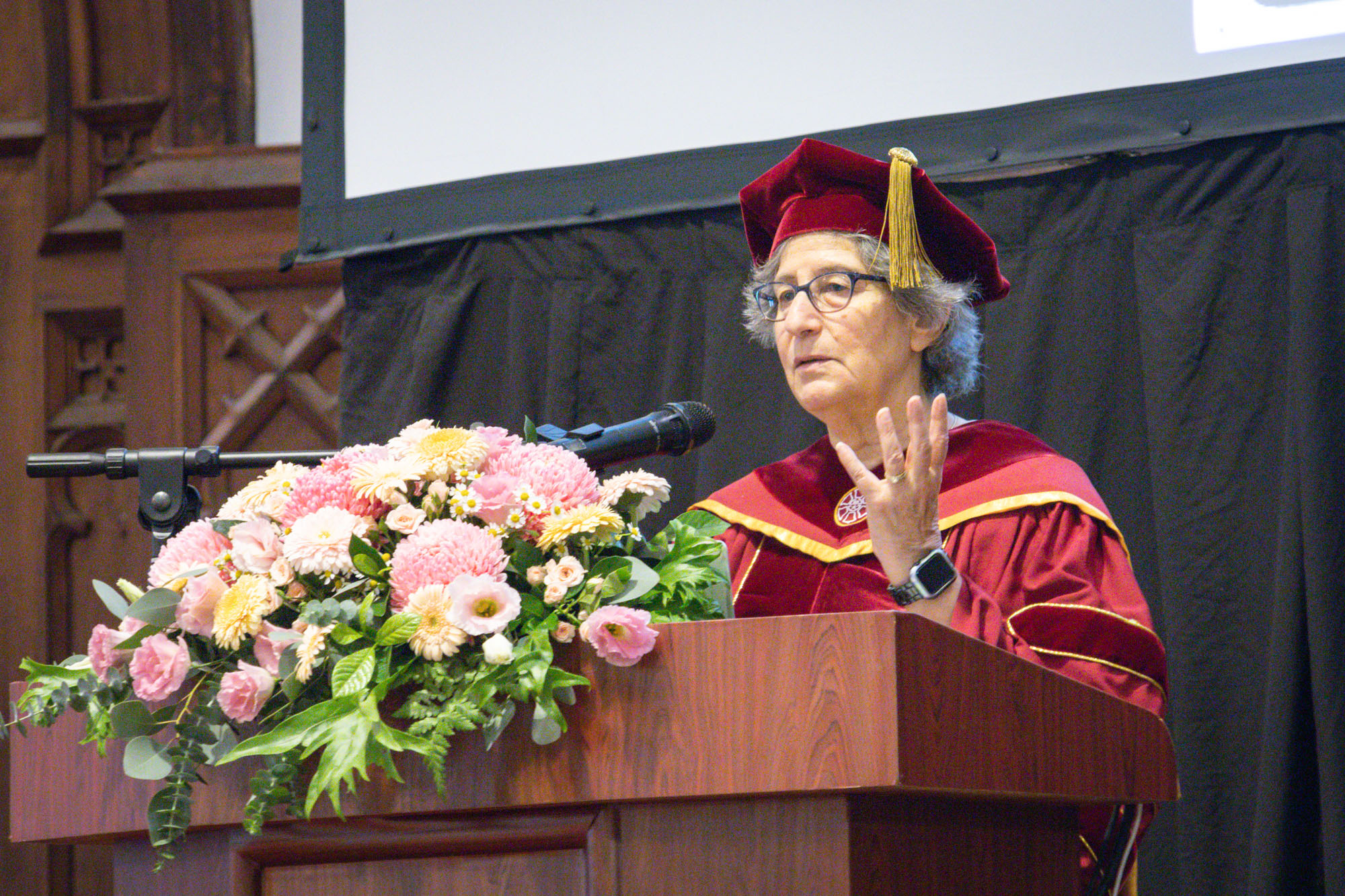
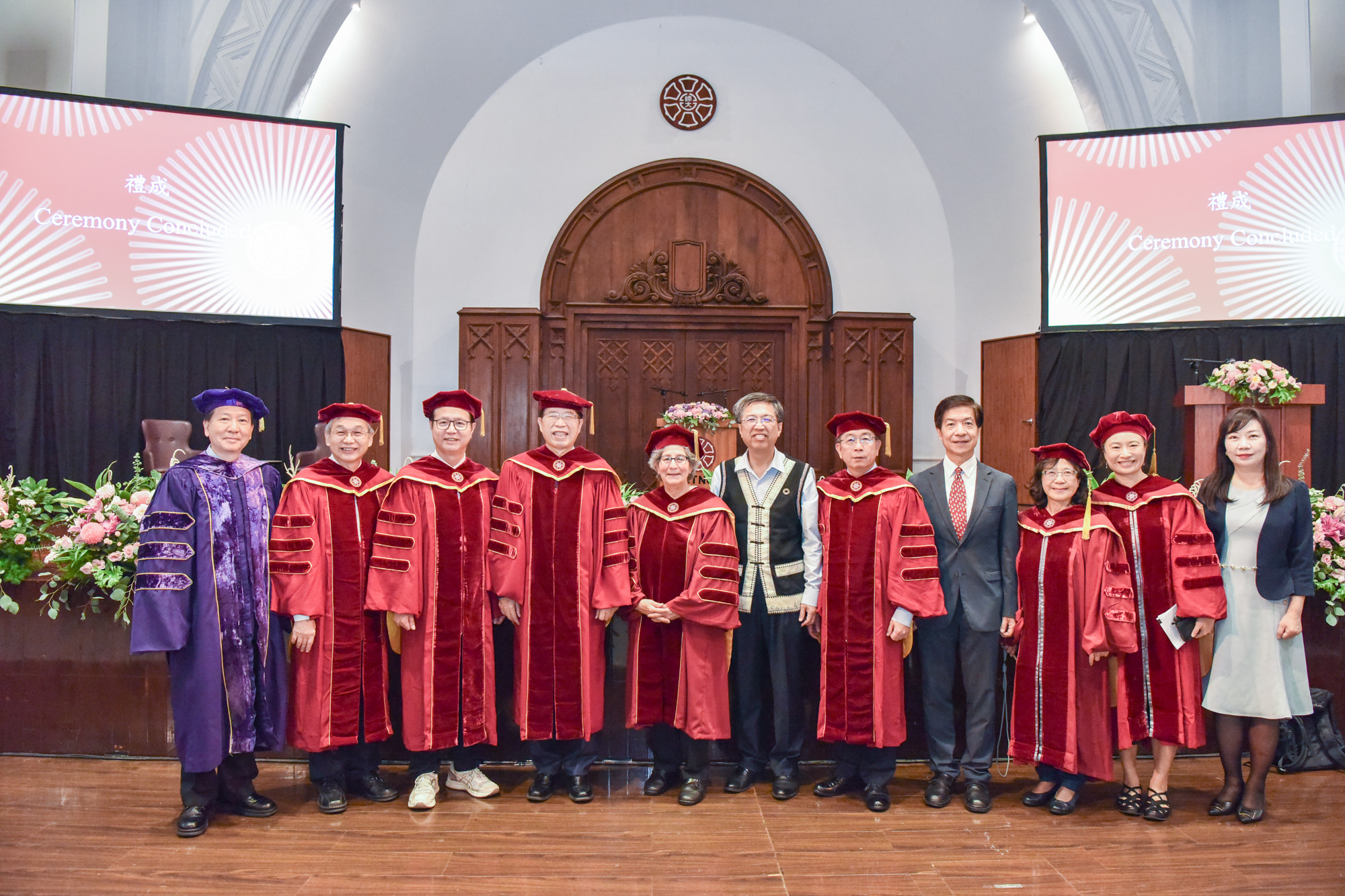
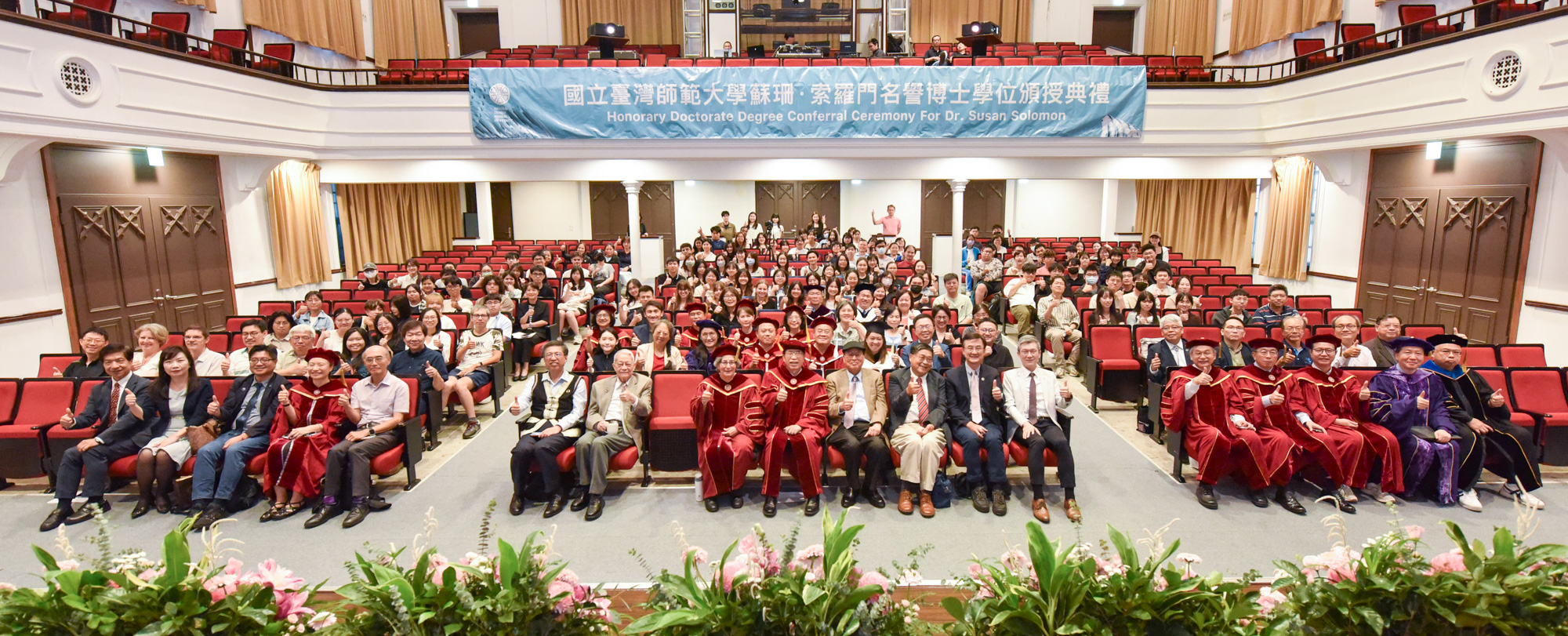
National Taiwan Normal University (NTNU) awarded an honorary Doctor of Science degree on September 23 to Susan Solomon, the 2026 Tang Prize laureate in Sustainable Development and the Lee and Geraldine Martin Professor of Environmental Studies at the Massachusetts Institute of Technology (MIT). The degree recognized Solomon’s contributions to atmospheric chemistry, ozone protection, and climate science, as well as the impact of her research on international environmental policy.
Following the ceremony at NTNU’s Heping Campus, Solomon delivered a lecture titled “Science, Society, and Solvable Environmental Problems Give Us Hope,” sharing how scientific discovery, public understanding, technological solutions, and international cooperation can work together to address global environmental challenges.
NTNU President Highlights Solomon’s Impact on Science and Society
Solomon was awarded the 2026 Tang Prize in Sustainable Development for her groundbreaking advances and leadership in atmospheric and climate sciences and their influence on global sustainable development policy.
NTNU President Yao-Ting Sung said the University was honored to confer the degree on Solomon, whose pioneering research helped explain the causes of the Antarctic ozone hole. Her work, he said, demonstrates how scientific discoveries can extend beyond academia to inform public policy and international cooperation. Sung noted that Solomon’s commitment to scientific inquiry, integrity, and action reflects values shared by NTNU. As a university with longstanding strengths in education and scientific research, NTNU seeks not only to advance knowledge but also to prepare students to turn knowledge into action that benefits society.
Dean Jein-Shan Chen of NTNU’s College of Science highlighted Solomon’s distinguished career and scientific achievements during the honorary degree ceremony. After earning her Ph.D. from the University of California, Berkeley, in 1981, Solomon built her career at the National Oceanic and Atmospheric Administration (NOAA) and MIT. Her contributions have earned her numerous honors, including the U.S. National Medal of Science and the Crafoord Prize.
Solomon highlights the path from scientific evidence to policy action
Among Solomon’s best-known contributions was her work during Antarctic ozone expeditions in 1986 and 1987, where her observations and analyses provided critical evidence linking chlorofluorocarbons (CFCs) to Antarctic ozone depletion. The growing scientific evidence helped provide a foundation for international action under the Montreal Protocol, which established measures to phase out ozone-depleting substances. Her research has also examined the long-term effects of carbon dioxide emissions on the climate system, contributing to scientific understanding of the lasting consequences of climate change.
During her lecture, Solomon drew on decades of ozone research to illustrate how an environmental problem that once appeared overwhelming became a global example of science contributing to effective action. She explained that solving environmental problems requires several conditions: the issue must matter to people, scientific evidence must make the problem understandable, and practical solutions must be available. Using the Antarctic ozone hole as an example, she described how scientists combined ground observations, satellites, weather balloons, high-altitude aircraft, laboratory studies, and computer models to understand the chemical processes behind ozone depletion.
Solomon emphasized that progress did not result from the work of any single scientist. Researchers, universities, government agencies, industries, and international organizations accumulated evidence over time, allowing scientific findings to inform government action. The resulting international cooperation under the Montreal Protocol led countries to progressively restrict and phase out chemicals that damage the ozone layer.
She also discussed evidence that the ozone layer is beginning to recover. Concentrations of major ozone-depleting CFCs in the stratosphere have declined, while observations of the Antarctic ozone hole show signs consistent with recovery. At the same time, she cautioned that factors including wildfires and chemical emissions could still affect that progress.
Science as a Source of Hope
Turning to today’s environmental challenges, Solomon said addressing them requires long-term commitment comparable to the determination behind the effort to reach the Moon. The ozone crisis of the 1980s once appeared daunting, she noted, but scientific research, public engagement, industrial innovation, and international policy ultimately changed its trajectory.
She encouraged younger generations in Taiwan and around the world not to focus only on the scale of climate and environmental problems, but to identify problems that can be solved. Scientific evidence, she emphasized, can provide a foundation for social engagement and practical action.
Through the honorary degree ceremony and Solomon’s lecture, NTNU recognized the achievements of a leading scientist while giving students and faculty an opportunity to see how scientific research can address major global challenges. The University will continue to strengthen connections among science, education, and sustainability, encouraging its community to understand the world through scientific inquiry and translate knowledge into action in response to environmental challenges.