Twenty-eight university faculty members from Taiwan stepped away from their summer break and returned to the classroom amid temperatures approaching 40°C in Texas. Through questions, discussions, teaching demonstrations, and reflection, they explored how to help university students better understand, participate in, and learn effectively in English-Medium Instruction (EMI) courses.
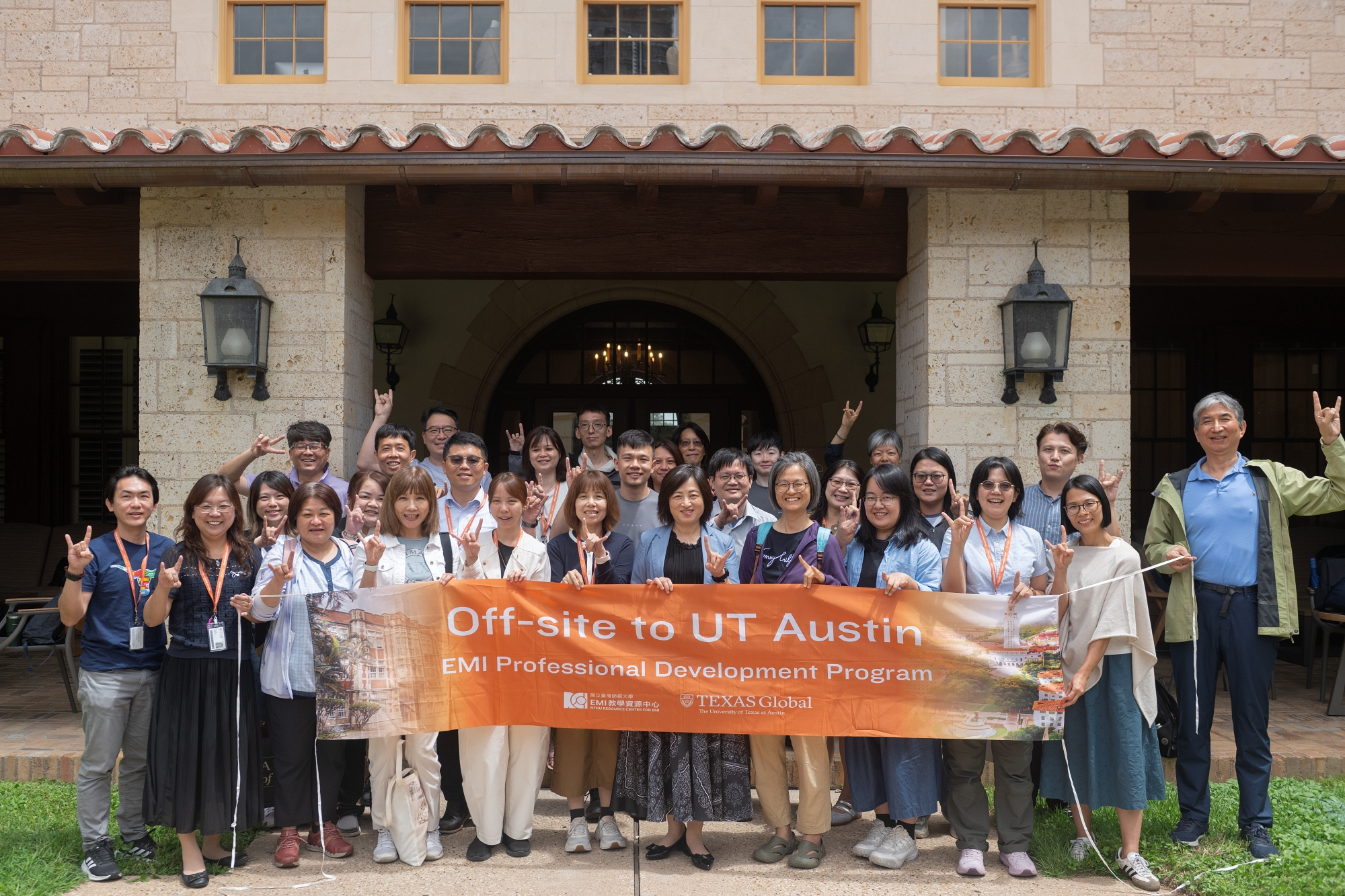
From July 13 to 24, 2026, the Resource Center for English-Medium Instruction (RCEMI) at National Taiwan Normal University (NTNU) partnered with The University of Texas at Austin (UT Austin) to conduct its third overseas EMI faculty training program, bringing together faculty members from 13 universities and colleges across Taiwan to transform their international training experience into practical teaching strategies. NTNU officially uses Resource Center for English-Medium Instruction (RCEMI) as the center’s English name.
NTNU began implementing the Program on Bilingual Education for Students in College in 2021, integrating bilingual education with internationalization, and was recognized by the Ministry of Education as a benchmark university for bilingual education in 2025. With support from the Ministry of Education, NTNU established RCEMI to provide consultation and professional development services for universities and colleges across Taiwan. The Center has collaborated with UT Austin, Columbia University, and the University of New South Wales to develop customized overseas training programs based on the needs of Taiwanese faculty. This third collaboration with UT Austin not only continues international exchange but also reflects NTNU’s long-term commitment to connecting international resources, local teaching needs, and professional support after participants return to Taiwan.
This year’s participants represented a wide range of disciplines, including education, humanities and arts, social sciences, business and management, natural sciences, information technology, engineering, medicine and health, social welfare, and aerospace. Bringing faculty from different disciplines together transformed EMI training from language development into an interdisciplinary exploration of how to promote effective learning.
The program was jointly developed by UT Austin’s international office and NTNU’s RCEMI. Before departure, participants completed an online course on multicultural teaching to better understand how to respond to students from different linguistic and cultural backgrounds. At UT Austin, they participated in academic English speaking and writing, comprehensive course design, classroom observations, workshops, and teaching demonstrations, progressing from understanding key concepts to designing and practicing their own teaching.
The training program used lesson plan and classroom observation tools developed by NTNU’s RCEMI, integrating course objectives, disciplinary content, language support, interactive activities, and assessment into a common framework. Through small-group discussions, peer feedback, and repeated revisions, participants transformed EMI principles into practical questions, tasks, and language scaffolding. Campus tours and learning resource activities at UT Austin also allowed participants to experience the perspective of cross-cultural learners and reflect on the support their own students may need.
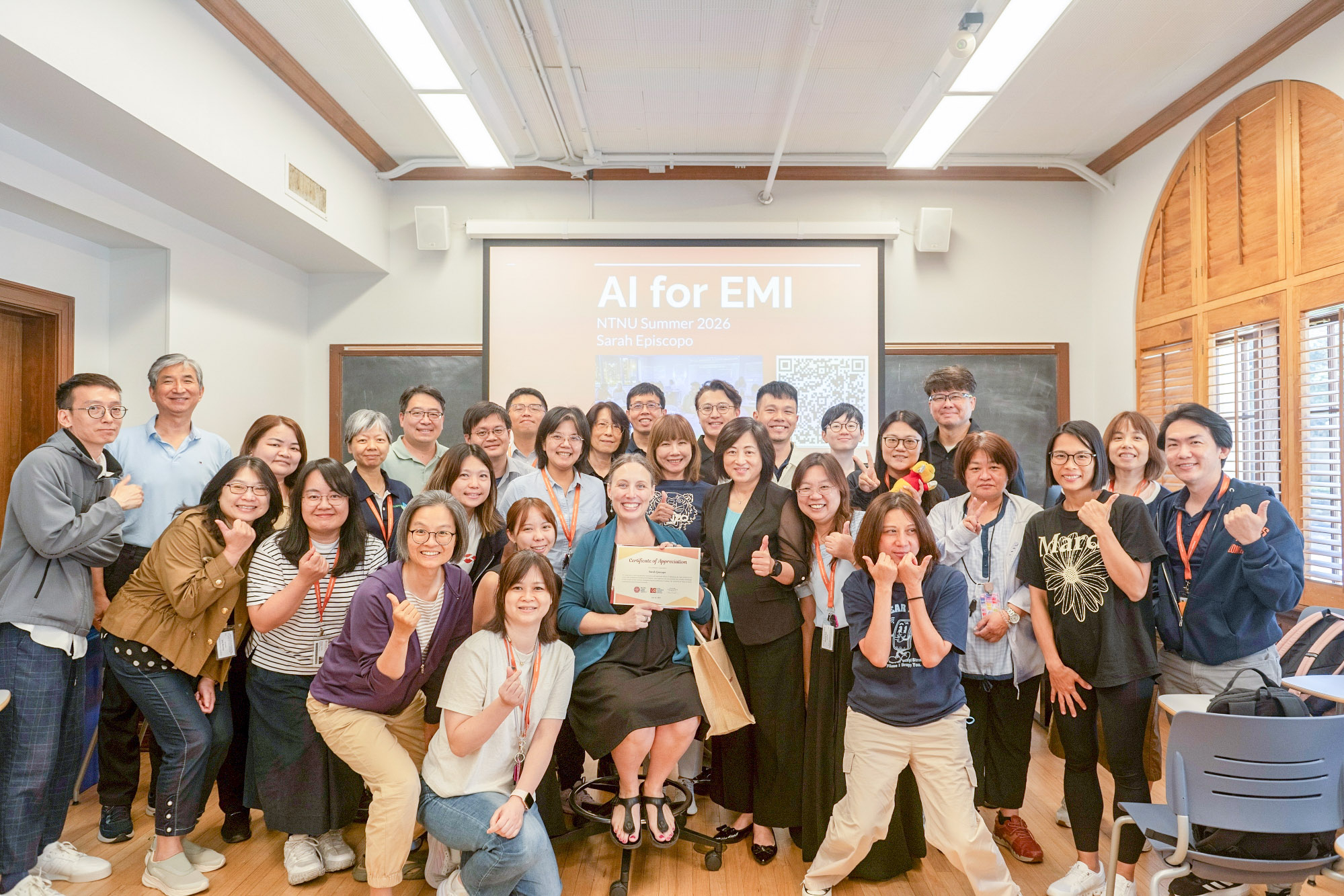
In response to strong demand from participants in the previous two programs, this year’s training included additional sessions on generative AI. Sarah Episcopo guided participants in using AI to develop lesson plans, teaching materials, language support, and classroom tasks, while encouraging them to consider how AI could genuinely support students’ understanding, participation, and expression rather than simply accelerate materials development. Participants completed several practical outcomes during the sessions, with many noting that they could apply what they had developed directly to their courses after returning to Taiwan.
Other workshops similarly emphasized practical application. Dr. Curt Reese used conversational games to demonstrate ways to increase classroom participation; Eric Uphoff guided participants in balancing disciplinary content, language support, and interactive design; Sarah Episcopo demonstrated effective strategies for encouraging student engagement; Jill Rolston-Yate guided participants in designing comprehensive EMI courses; and Dr. Michael Smith focused on learning motivation and ways to create a more supportive classroom environment. At the end of the program, each participant integrated what they had learned over the two weeks into a teaching demonstration and received peer and expert feedback using NTNU’s classroom observation form.
Mei-Hui Liu, Executive Director of NTNU’s RCEMI, said, “Professional development for EMI faculty should not end with short-term overseas training. Systematic support before, during, and after the program is essential to transform international learning experiences into teaching outcomes that can be implemented, shared, and continuously improved.” After returning to Taiwan, participants will continue with mentoring, lesson plan refinement, classroom implementation, open classroom observation and discussion, and cross-university professional communities. Participants from all three cohorts will also gather at NTNU on November 13 and 14 to share their experiences and reflections on applying what they learned overseas to classrooms in Taiwan.
Associate Professor Min-Hua Chen of the Department of Biomedical Engineering at Chung Yuan Christian University described the program as the most substantial and practical overseas EMI training he had attended. From pre-departure online courses to on-site discussions, classroom observations, and feedback, the program allowed him not only to understand the theory but also to repeatedly practice applying it to teaching.
Distinguished Professor and University Librarian Hui-Yun Sung of National Chung Hsing University said the two-week immersive learning experience gave her a deeper understanding that EMI is not simply about teaching disciplinary knowledge in English, but also about incorporating equity, diversity, and inclusion into course philosophy, design, and teaching practice.
Professor and Director Chuan-Yu Ko of the General Education Center at National Taiwan University of Arts said, “The enthusiastic and collaborative learning among 28 colleagues made it well worth traveling across the Pacific to study EMI in the nearly 40-degree Texas heat. The laughter, questions, and discussions were the best reflections of these two weeks.”
The overseas training program may have a set duration, but NTNU’s professional support continues after participants return home. All participating faculty members are required to take part in open classroom observations and discussions, cross-university faculty communities, and presentations of teaching practice research. To date, the Center has trained more than 100 faculty members, gradually building a network of EMI faculty across universities in Taiwan. Through international collaboration, local support, and the sharing of outcomes, NTNU is developing a sustainable model for EMI faculty professional development, turning a single overseas training experience into changes across more classrooms and contributing to the long-term internationalization of higher education in Taiwan.