


|
|

Many children today grow up as only children, and even within extended families, cousins are not always part of the picture—so it is often not until children enter school that they have their first real encounters with peers their own age. To understand how peers shape the social development of children who do and do not have siblings, a research team led by Associate Professor Li-Tuan Chou and Assistant Professor Shu-Man Huang of the Department of Child and Family Science at National Taiwan Normal University (NTNU) drew on longitudinal data from the Kids in Taiwan (KIT) database. The team found that both siblings and peers help children develop independence, assertiveness, and sociability—and that for only children without siblings, peer relationships play an especially important role.
Although the Kids in Taiwan (KIT) study began later than comparable surveys in Europe and the United States—the project was launched in 2014, with its national survey commencing in 2016—it is the first nationally representative longitudinal database of early childhood development in Chinese societies. The 36-month-old cohort used in this study comprises 4,260 children drawn from national household registration records through stratified two-stage probability-proportional-to-size (PPS) sampling. Beginning at 36 months of age, the cohort has been followed at 36, 48, and 60 months, with follow-ups planned to continue through senior high school.
For this study, the researchers selected two groups of children—those who already had siblings at 36 months of age, and those who remained only children at 60 months—for a combined sample of 1,590 children. Using Mplus latent growth modeling (LGM), the team analyzed how four dimensions of social competence—independence, assertiveness, sociability, and compliance—developed between the ages of 3 and 5, and further examined how sibling relationships and peer interaction shaped that development.
“Most of the competencies adults rely on are formed in childhood,” said Chou. She noted that as birth rates are declining, more and more children are growing up without siblings. In the past, even a child without siblings often had cousins living under the same roof in a large extended family, but that can no longer be taken for granted today. Since these children will still need to navigate social life as adults, how they gain social experience has become an important question—which is why the team wanted to examine what happens when a child has limited exposure to siblings, and how peer relationships might factor into that.
To carry out the study, Huang explained, the team compared only children and children with siblings separately, examining how peer experience recorded across three waves of data collection influenced each of the four dimensions of social competence. The results showed that only children showed higher initial levels in all four dimensions than children with siblings, but children with siblings developed faster across all four dimensions over time.
As children grew older, Huang noted, the influence of peer experience on social competence gradually diminished year by year. Even so, peer experience continued to have a significantly greater positive effect on the social competence of only children than on that of children with siblings.
The study confirmed that both siblings and peers play a critical role in the development of children's social competence, and showed clearly that children who have both siblings and peer experience develop the strongest social competence of all. According to Huang, siblings and peers each help children build social competence, but for only children without siblings, peers can serve much the same function. She therefore recommends that only children start school earlier, so they can begin drawing on the benefits of peer interaction sooner.
The study also found that children with siblings show healthy development across all four dimensions of social competence. For children without siblings, however, having peers is linked to significant gains in independence, assertiveness, and sociability, but not in compliance, which showed no significant benefit and even tended toward a negative effect.
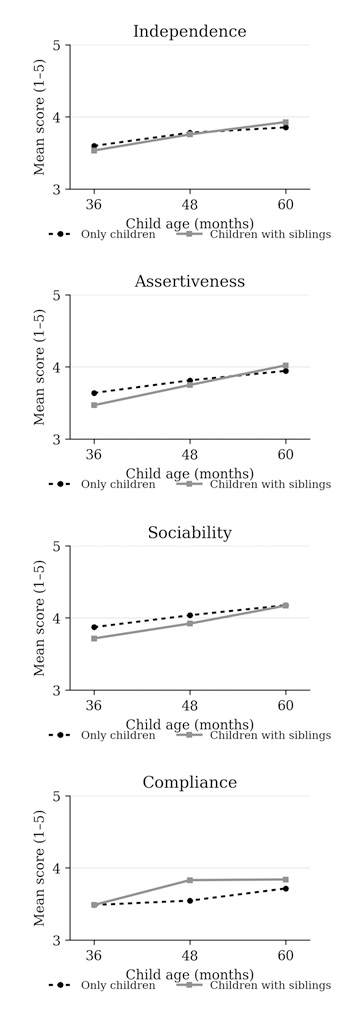
Figure caption: Latent growth model (LGM) estimates of social competence, using sibling status (“with siblings” versus “only child”) and years of peer experience as covariates.
Compliance broadly refers to a child's ability to behave in ways that meet the expectations of a given social setting—for example, stopping a game when asked to do so. Huang suggested that this finding may reflect the fact that the parents surveyed tended to be relatively young, and that “compliance” is no longer a parenting value that today's parents place much emphasis on. She also noted that the children with siblings in the study may be the second or third child in the family, and that birth order and sibling structure could likewise have influenced the results.
Looking toward future research directions, Chou noted that the KIT database is continuing to collect data. While the current study could only track children up to 60 months of age, the database now includes data on children through the fifth and sixth grades of elementary school. The social competence children build in preschool tends to undergo an even greater shift once they enter elementary school, and Chou believes this transition is well worth further research investment—work that would help paint a fuller picture of sibling relationships in Chinese-speaking societies.
Source: Huang, S.-M., Chou, L.-T., Wu, T.-J., & Yip, M. F. (2023). Influence of peers on the growth trajectory of the social competence of only children and children with siblings. Bulletin of Educational Psychology, 54(3), 609–636. https://doi.org/10.6251/BEP.202303_54(3).0005
Shu-Man Huang Assistant Professor | Department of Child and Family Science
Shu-Man Huang is an Assistant Professor in the Department of Child and Family Science, where her research focuses on family emotional interaction, marriage and family relationships, adolescents and families, and sibling relationships, alongside her work in individualized family life education services. Her research examines the relational dynamics of families with different structures, with the goal of promoting the healthy development of children and families.
Li-Tuan Chou Associate Professor | Department of Child and Family Science
Li-Tuan Chou is an Associate Professor in the Department of Child and Family Science. She has spent many years working in the areas of family education, family theory, and work-family balance, with a research portfolio spanning family education issues, parenting, and family life assessment. She has published numerous academic papers and taken part in the Ministry of Education's family education outreach programs, working to strengthen the public impact of family education.

